Active Directory: the identity backbone of the enterprise
Active Directory (AD) remains the backbone of enterprise identity, access management (IAM), and digital trust. By centralizing authentication and access control, AD provides the foundational framework required to secure resources across hybrid, multi-cloud, and on-premises environments—incorporating core services like AD DS for domain operations, AD CS for internal PKI, AD FS for federation, AD RMS for persistent data protection, AD LDS for lightweight applications, and Hybrid Identity to bridge cloud ecosystems. Modernizing AD through routine maintenance, schema auditing, and Zero Trust alignment is vital for compliance and resiliency.
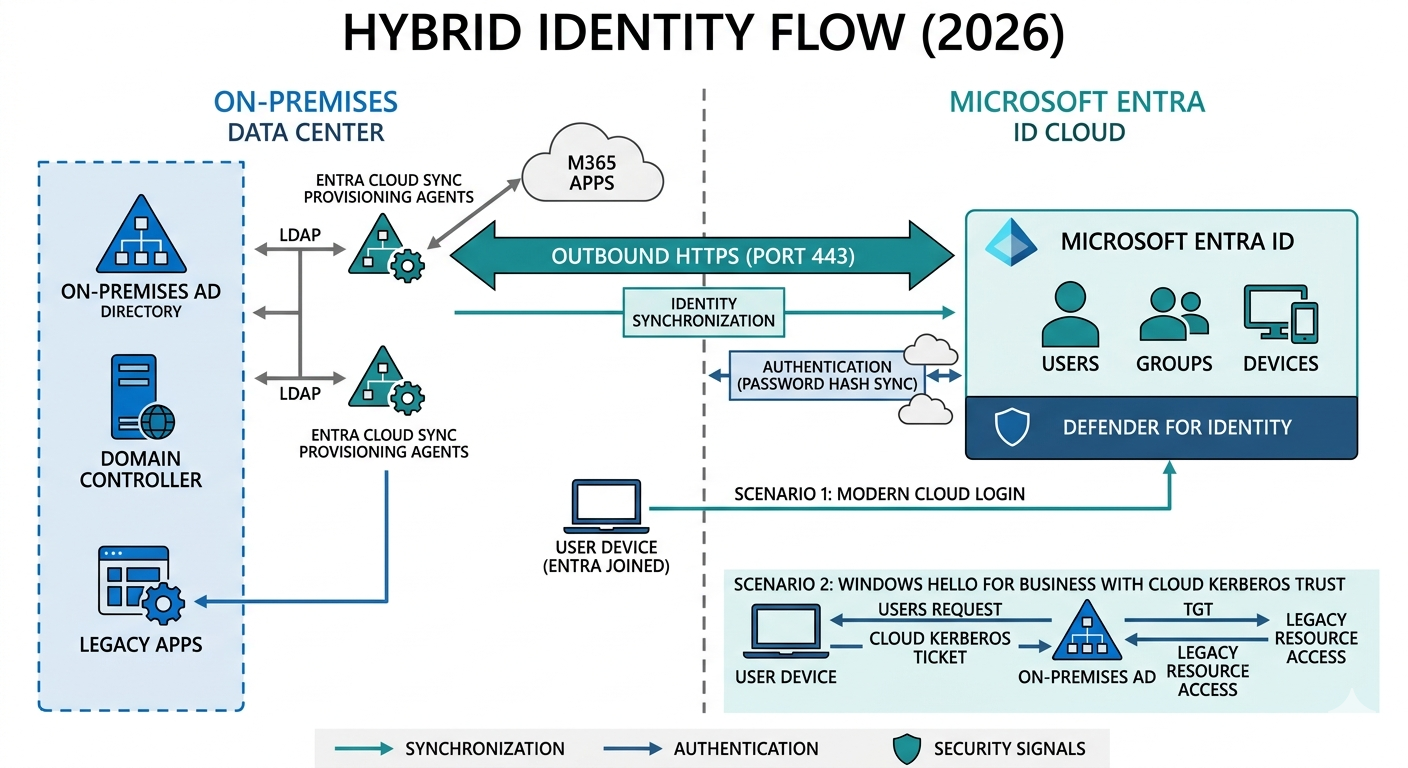
On-Premises AD ⇄ Entra ID
Microsoft Entra Connect syncs directory objects from on‑premises Active Directory to Entra ID, enabling hybrid identity and unified access. Users authenticate once and gain single sign‑on to both legacy and cloud‑native applications, with consistent security policies applied across the entire estate — eliminating the need to manage two identity stores manually.
Explore key Active Directory components and supporting services — each link provides in‑depth coverage:
Core Infrastructure Roles & Services
Key AD roles and supporting services — search to filter, or scroll to see the entire stack.
Domain Controller
The heart of AD authentication and authorization. Upgraded to Windows Server 2025 with raised functional levels for enhanced security features and performance, ensuring reliable identity verification across the network.
AD Domain Services
Governs domain architecture, FSMO roles, replication, schema extensions, and site topology. Houses core user, group, and computer objects, supporting Kerberos/NTLM authentication and LDAP queries for centralized administration.
Hybrid Identity (Entra Connect)
Bridges on-premises AD with cloud ecosystems via Microsoft Entra Connect. Enables Seamless SSO, Password Hash Sync, and Passthrough Authentication for unified cloud access governance.
Certificate Services
Acts as internal PKI infrastructure, issuing and managing digital certificates for multi-factor authentication, enterprise S/MIME, IPsec, and SSL/TLS encryption across the network estate.
Federation Services
Enables cross-organizational single sign-on (SSO) and identity federation across legacy apps, cloud platforms, and external partner networks using SAML, WS-Federation, and OAuth protocols.
Rights Management Services
Enforces persistent data protection, encryption, and rights-management policies to safeguard sensitive documents and emails against unauthorized access, even when shared externally.
Lightweight Directory Services
Offers flexible, data-driven LDAP directory instances for directory-enabled applications without requiring full domain controller deployments or domain schema modifications.
AD‑Integrated DNS
Active Directory relies on DNS for domain controller location, replication, and service discovery. AD‑integrated zones store DNS data in the directory for secure, multi‑master replication and dynamic updates.
Group Policy Objects
Centralized configuration management for users and computers. GPOs apply security settings, deploy software, and enforce compliance, fine‑grained password policies, and administrative templates across the domain.
Windows Server Update Services
Patch management solution using AD groups and GPOs to target updates to specific computers, ensuring servers and workstations receive security patches reliably.
File Server & DFS
Enterprise file shares secured with AD‑based permissions (ACLs). DFS Namespaces provide a unified logical namespace, while DFS Replication keeps data synchronized across multi-site environments.
FSMO Roles
Flexible Single Master Operations roles (Schema Master, Domain Naming Master, RID Master, PDC Emulator, Infrastructure Master) manage specialized single-master tasks to ensure directory integrity and avoid replication conflicts.
No roles match that search — try a different term, or clear the box to see all roles.
Need this hardened, migrated, or brought current?
Get in touch →